Pakistan’s Call Center Industry: Understanding the Rise of Illegal Activities
Pakistan's call center industry hides a growing fraud problem. Here's how illegal call centers operate, who they target, and why it persists.
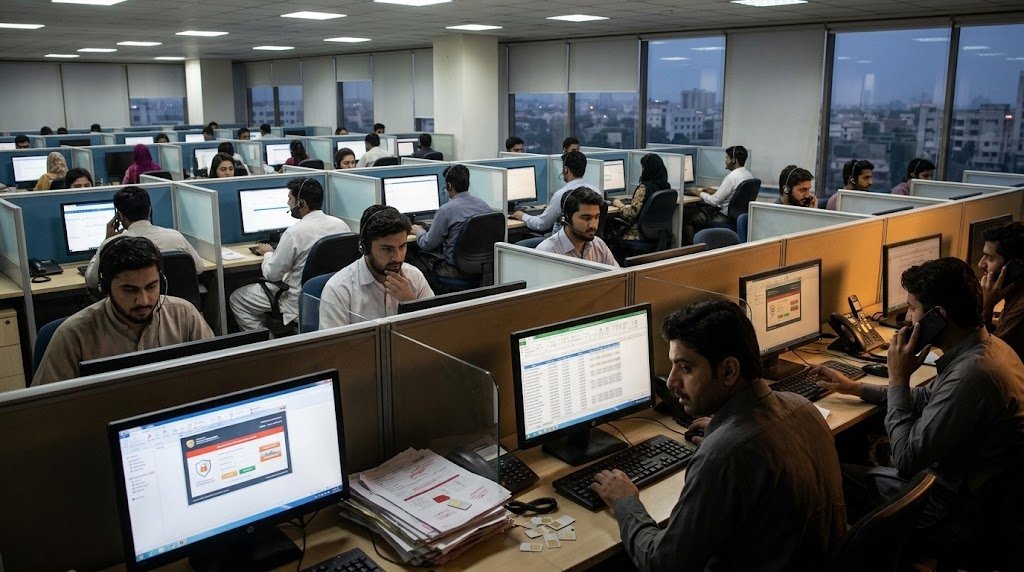
Pakistan’s call center industry has quietly become one of the country’s most contradictory success stories. On paper, it’s a booming export sector that employs hundreds of thousands of young people and brings in foreign exchange. In practice, a sizable chunk of that same industry has turned into a cover for international fraud, data theft, and money laundering. Walk through commercial plazas in Lahore, Karachi, or Islamabad and you’ll see the same pattern: legitimate-looking offices with polished signage, headset-wearing employees working night shifts, and, behind closed doors, scripts designed to con people in the US, UK, Canada, and Europe out of their savings.
This isn’t a fringe problem. Estimates put the number of unregistered or semi-legal call centers operating in Pakistan somewhere close to 1,000, employing close to a million people combined with the legitimate sector. Not all of them are running scams, but enough are that the entire industry’s reputation has taken a hit, both locally and internationally. Meanwhile, raids, arrests, and corruption scandals involving the very agencies meant to police this space have made headlines repeatedly over the past two years.
This article looks at how Pakistan’s call center industry got here, what illegal activities actually look like on the ground, real cases that have surfaced, and what would genuinely need to change for the situation to improve. The goal isn’t to demonize an entire sector that also does honest, valuable work. It’s to look honestly at a problem that keeps growing because the incentives around it haven’t been fixed.
A Booming Industry With a Dark Side
Pakistan built its call center sector the same way India and the Philippines did: cheap English-speaking labor, decent internet infrastructure, and a young population willing to work odd hours for foreign clients. Legitimate operations handle customer support, telemarketing, IT helpdesks, and lead generation for companies abroad. Many of these are properly registered, pay taxes, and offer stable jobs to fresh graduates.
The trouble is that the same setup, an office full of headsets, VoIP lines, and people trained to sound convincing on the phone, works just as well for fraud as it does for legitimate business. A scam call center needs almost nothing more than what a real one already has, which makes it remarkably easy to set one up, and just as easy to disguise once it’s running.
Why the Line Between Legal and Illegal Gets Blurry
A lot of people assume scam operations are obviously shady from the outside. They usually aren’t. According to industry insiders and several investigative reports, many fraudulent centers:
- Register as legitimate businesses offering “digital services,” software exports, or web development, which gives them access to banking facilities and government incentives meant for genuine IT exporters
- Run a mix of real client work alongside fraudulent campaigns, so a portion of their revenue looks completely clean
- Hire fresh graduates and job seekers who have no idea, at least initially, that the “international sales” job they signed up for is actually a scam operation
- Operate out of ordinary commercial buildings and residential plazas, often in the same complexes as legitimate businesses
This blending is deliberate. It makes the sector very hard to police, because regulators, banks, and even landlords often can’t tell the difference between a real customer service floor and a fraud operation until money trails or victim complaints force an investigation.
Common Types of Illegal Activities in Pakistan’s Call Centers
Fraudulent call centers in Pakistan don’t run one type of scam. Over the years, several patterns have shown up again and again in FIA and NCCIA investigations.
1. Tech Support and Bank Impersonation Scams
This is probably the most well-known model. Employees pose as representatives of major banks, tech companies, or government agencies, usually targeting people in the US, UK, or Canada. Common scripts include:


- Fake fraud alerts claiming a target’s bank account or credit card has been compromised
- Pretend “Microsoft” or “Apple” support calls convincing victims their computer has a virus
- Requests for remote access to a victim’s device, followed by theft of banking credentials or direct fund transfers
In one widely reported case, a Karachi call center was raided after agents were caught impersonating US bank staff and stealing Social Security numbers and credit card details from American citizens.
2. The “Dabba Trading” and Investment Fraud Model
Some operations run fake investment platforms or unregulated trading schemes, often referred to locally as “dabba” trading. Victims are convinced to deposit money into what looks like a legitimate trading or investment app, watch fabricated returns build up on a dashboard, and are then blocked or ignored the moment they try to withdraw funds.
3. Loan Apps and Online Gambling Fronts
A more recent trend involves call centers tied to fraudulent loan apps and gambling platforms. A major crackdown, publicly referred to as “Operation Grey,” was launched after the State Bank of Pakistan flagged suspicious transactions worth billions of rupees moving through accounts linked to roughly three dozen companies. Investigators found the network’s revenue came from a mix of online gambling, fake loan apps, call center fraud, and bogus investment platforms, with individuals from more than ten countries involved in running it.
4. Romance and Relationship Scams
Some centers specialize in long-term “romance scam” scripts, building fake relationships with lonely or vulnerable victims over weeks or months before requesting money for emergencies, travel, or investment opportunities. These operations require patience and emotional manipulation more than technical skill, and they tend to be some of the hardest to trace because the money moves gradually rather than in one large transaction.
5. Data Theft and Identity Fraud
Beyond direct financial scams, some call centers exist purely to harvest personal data (names, addresses, card numbers, Social Security numbers) which is then sold on to other criminal networks or used for identity theft down the line.
Real Cases That Exposed the Problem
Talking about illegal call centers in Pakistan in the abstract doesn’t capture how large and organized this has become. A few cases from the past couple of years illustrate the scale.
The Heart Sender Group (Lahore and Multan): This network was dismantled after investigators linked it to roughly $50 million in losses suffered by US citizens. Reports on the case described its leaders living lavishly, with luxury cars and property in Dubai, funded almost entirely by proceeds from the scam operation.
Faisalabad Raid: Police apprehended 149 people, including 48 Chinese nationals, in a single raid on a scam call center, highlighting how these operations increasingly involve foreign nationals acting as on-ground managers or technical operators.
Islamabad’s Rs172 Billion Laundering Case: The FIA reopened investigation into a call center network accused of funneling roughly Rs172 billion through the formal banking system, with suspicions that senior government officials helped facilitate the operation. This case, first uncovered in 2025 and reopened after fresh evidence, shows how deep the money laundering side of this problem can run.
Rawalpindi Extortion Network: A separate scandal revealed that officers within Pakistan’s own cybercrime agency were allegedly extorting close to Rs15 million a month from a network of fifteen illegal call centers in a housing society, in exchange for looking the other way. This wasn’t an isolated bribe. It pointed to a structured protection racket operating inside the very institution meant to shut these centers down.
F-11 Islamabad Raid: During one operation, 14 Chinese nationals were arrested at a call center, and it later emerged that bribes totaling Rs21 million had allegedly been paid to secure their release, with records showing how the money was distributed among officials involved.
These aren’t isolated bad-apple stories. Between January 2024 and June 2025 alone, authorities conducted 63 raids on illegal call centers nationwide, and yet an estimated 300 or more are believed to still be operating. The arrests generate headlines, but the underlying network rarely gets fully dismantled.
Why the Problem Keeps Growing
If raids and crackdowns keep happening, why does the industry keep expanding? A few structural reasons stand out.
Weak Regulatory Oversight
The Pakistan Telecommunication Authority (PTA) has often stated that illegal call centers fall outside its direct jurisdiction, leaving enforcement scattered across multiple agencies with overlapping and sometimes unclear mandates. When no single regulator owns the problem end-to-end, gaps are inevitable.
Corruption Within Enforcement Agencies
Perhaps the most damaging factor is that some of the officials responsible for shutting these operations down have instead been protecting them for a cut of the profits. When a fraud network can simply pay off inspectors, arrests become a cost of doing business rather than a genuine deterrent.
Easy Access to Financial Infrastructure
Because many fraudulent centers register as legitimate IT or digital services companies, they gain access to business bank accounts, government tax incentives, and international payment gateways with relatively light scrutiny. Once inside the formal financial system, laundering proceeds through hawala and hundi networks or converting them into cryptocurrency becomes much easier.
Predatory Recruitment of Vulnerable Youth
Pakistan has a large, well-educated, English-speaking population with limited formal job opportunities. Scam operations exploit this directly, advertising well-paying “international sales” or “customer service” roles, then gradually pulling new hires into fraudulent scripts once they’re financially dependent on the job. Many employees, particularly younger ones, genuinely don’t realize they’re part of a criminal enterprise until well after they’ve started.
Low Risk of Serious Punishment
Fines for operating an unlicensed call center are often modest enough that they’re treated as a routine business expense. Cybercrime cases can also drag on for years in courts that lack specialized training in digital evidence, which reduces the real-world deterrent effect of getting caught.
The Human and Reputational Cost
It’s worth being clear that this problem creates victims on both ends of the phone line.
- Foreign victims lose savings, retirement funds, and in some cases their entire financial security to scripted, well-rehearsed fraud calls
- Pakistani employees, especially young or first-time job seekers, are often pulled into criminal activity without fully understanding the consequences, and can face arrest, deportation of foreign co-workers around them, or long-term legal trouble
- Legitimate call center businesses suffer reputational damage by association, making it harder for genuine Pakistani IT and BPO companies to win trust and contracts from international clients
- The country’s global standing takes a hit every time a large fraud network tied to Pakistan makes international news, which affects everything from foreign investment sentiment to visa scrutiny for Pakistani workers abroad
What Would Actually Need to Change
Most proposals for fixing this problem circle back to a similar set of ideas. The challenge has never really been a lack of solutions. It’s been a lack of follow-through.
- Centralized regulatory authority — One agency needs clear, undisputed jurisdiction over call center licensing and enforcement, rather than the current patchwork where agencies point fingers at each other.
- Genuine accountability inside enforcement agencies — Officers caught taking bribes or running protection rackets need to face prosecution, not quiet transfers or administrative slaps on the wrist.
- Specialized cybercrime courts — Judges trained specifically in digital evidence and financial fraud could resolve cases faster and with more consistent outcomes than general courts currently manage.
- Stronger banking due diligence — Banks and financial regulators need tighter checks on companies claiming to be “IT exporters” or “digital service providers,” since this label is one of the most common covers used by fraud operations.
- SIM and telecom accountability — A stricter biometric verification system tied to every SIM card, combined with faster response times when numbers are reported for scam activity, would reduce how easily these operations can keep functioning.
- Public awareness campaigns — Both for potential job seekers, so they can recognize warning signs before accepting a role at a fraudulent operation, and for the general public, so scam scripts become easier to recognize and report.
None of this is complicated in theory. It requires political will that hasn’t consistently existed, partly because some of the same institutions meant to enforce these changes have financial incentives not to.
How International Cooperation Fits In
Because most victims of Pakistan’s illegal call centers are based abroad, international cooperation plays a real role in disrupting these networks. Agencies like the Federal Trade Commission in the United States track and publish data on cross-border scam patterns, which can help identify networks operating out of specific regions. Cybersecurity and fraud researchers at organizations such as the Internet Crime Complaint Center (IC3), run by the FBI, also collect victim reports that frequently trace back to South Asian call center operations, giving Pakistani investigators additional leads when cases are shared across borders.
Better data-sharing agreements between Pakistani agencies and their counterparts abroad, along with faster mutual legal assistance processes, would make it considerably harder for these networks to keep moving money and evading consequences once a case crosses international lines.
Conclusion
Pakistan’s call center industry sits at an uncomfortable intersection: a genuinely valuable export sector on one side, and a well-documented hub for international fraud on the other. The illegal activities within it, from bank impersonation scams and fake investment schemes to large-scale money laundering, aren’t small or hidden anymore. Cases like the Heart Sender Group, the Rs172 billion Islamabad laundering scandal, and the corruption uncovered within Pakistan’s own cybercrime agency all point to a problem that has grown well past the point of being solved with occasional raids. Real change would require centralized oversight, honest accountability inside enforcement agencies, tighter financial scrutiny, and sustained international cooperation. Until those pieces come together, the gap between Pakistan’s legitimate call center success story and its fraud-driven shadow industry is likely to keep widening.