AI Staffing Shortage Solutions: 7 Powerful Ways Automation Is Revolutionizing Frontline Work
AI staffing shortage pressures are pushing companies toward automation. Here's how frontline hiring, scheduling, and retention are changing fast.
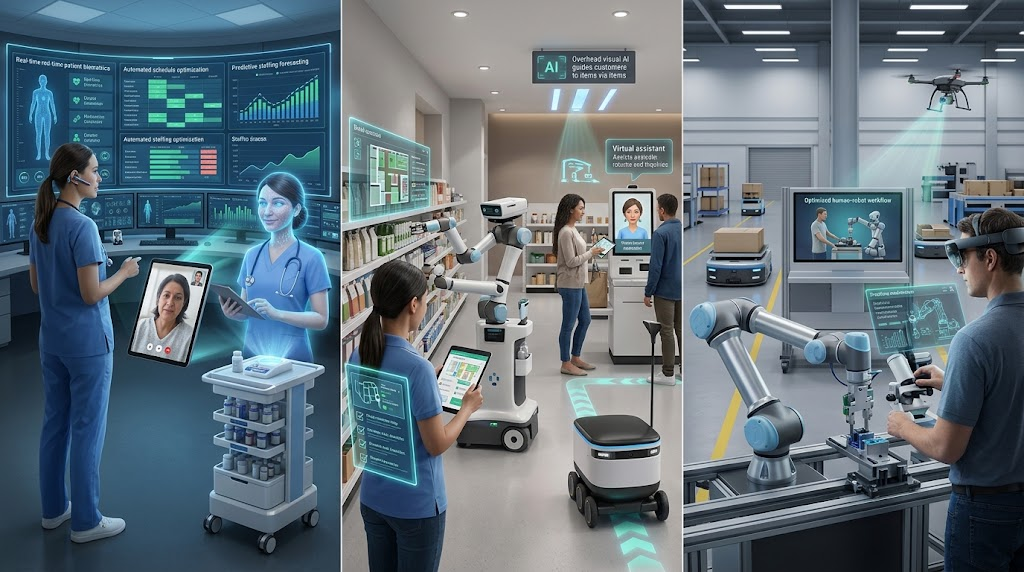
AI staffing shortage problems have moved from a back-office concern to a boardroom priority. Retailers can’t keep shelves stocked, hospitals are stretched thin on nursing coverage, warehouses are missing pick-and-pack targets, and restaurants are cutting hours because there simply aren’t enough hands on deck. At the same time, a wave of artificial intelligence tools has arrived at exactly the moment companies need them most. The result is a quiet but massive shift in how frontline staffing works, one that touches recruiting, scheduling, training, and even the day-to-day tasks employees perform.
This isn’t a story about robots replacing people at scale, at least not yet. It’s a story about labor shortages forcing employers to rethink how work gets done, and about automation filling gaps that used to require a warm body and a punch clock. Grocery chains are testing self-checkout expansions. Hospitals are using AI-driven scheduling to cut nurse burnout. Call centers are routing more conversations to bots so human agents can handle the calls that actually need a person.
If you manage frontline teams, hire hourly workers, or just want to understand where this is all headed, this article breaks down what’s driving the shift, which technologies are doing the heavy lifting, and what it means for the future of frontline jobs. We’ll also look at where automation still falls short, because the shift is real, but it’s not simple.
The Frontline Labor Shortage Isn’t Going Away Anytime Soon
Before getting into automation, it’s worth understanding why the labor shortage in frontline industries has stuck around longer than most economists predicted a few years ago.
Frontline roles, meaning jobs in retail, hospitality, healthcare, warehousing, food service, and transportation, have always had high turnover. But several forces have combined to make the current shortage deeper and more stubborn:
- Demographic shifts — Baby boomers are retiring out of the workforce faster than younger workers are entering physically demanding jobs.
- Changing worker expectations — Many hourly workers now prioritize flexible scheduling, better pay, and mental health support over just having “a job.”
- Post-pandemic career shifts — A meaningful chunk of the workforce moved away from customer-facing roles entirely after 2020, and many haven’t come back.
- Wage competition — Employers are bidding against each other for the same shrinking pool of applicants, which drives up costs without necessarily fixing the shortage.
According to the U.S. Bureau of Labor Statistics, several frontline occupational categories, including healthcare support and food preparation, are projected to keep growing in demand even as the available labor pool tightens. That mismatch between demand and supply is exactly why AI and labor shortages have become so tightly linked in workforce planning conversations. Employers aren’t waiting for the labor market to fix itself. They’re building around it.
Why Traditional Hiring Fixes Aren’t Enough
Raising wages, offering signing bonuses, and loosening hiring requirements have all been tried, and they help a little. But they don’t solve the underlying math problem: there are more open frontline roles than there are people willing and able to fill them in many regions. That gap is what’s pushing companies toward technology as a structural fix rather than a temporary patch.
How AI Is Already Reshaping Frontline Staffing
AI-powered staffing tools have quietly become standard in industries that used to run entirely on paper schedules and gut-feel hiring decisions. Here’s where the change is most visible.
1. AI-Driven Recruiting and Screening
Hiring for hourly roles used to mean sorting through stacks of applications by hand. Now, AI recruiting tools can:


- Scan resumes and applications for relevant experience in seconds
- Conduct initial chatbot-based screening interviews
- Rank candidates based on predicted job fit and retention likelihood
- Automatically schedule interviews without back-and-forth emails
This matters most in high-volume hiring environments like retail and warehousing, where a single location might need to fill dozens of positions in a matter of weeks. Speed is often the deciding factor, since good candidates accept the first solid offer they get.
2. Smarter Scheduling Systems
Scheduling has historically been one of the biggest pain points in frontline management. Managers had to balance labor laws, employee availability, skill requirements, and demand forecasts, often with a spreadsheet and a lot of guesswork.
AI scheduling software now handles this by:
- Predicting staffing needs based on historical sales or patient volume data
- Automatically filling shifts based on employee preferences and availability
- Flagging compliance risks like overtime violations or insufficient rest periods
- Letting employees swap shifts through an app instead of calling a manager
This kind of automation doesn’t just save management time. It directly improves retention, since unpredictable scheduling is one of the top reasons hourly workers quit.
3. Chatbots and Virtual Assistants for Customer-Facing Roles
In retail, banking, and customer service, AI chatbots are absorbing a growing share of routine interactions, freeing up human staff for more complex or emotionally sensitive conversations. This shift is especially visible in call centers, where AI can now handle basic account questions, order tracking, and appointment scheduling without a human ever picking up.
4. Robotics and Physical Automation
Warehousing and logistics have moved the fastest here. Automated guided vehicles, robotic picking arms, and inventory-scanning drones are increasingly common in distribution centers. This isn’t about replacing every warehouse worker. It’s about reducing the number of repetitive, physically taxing tasks that were hardest to staff in the first place.
5. Predictive Analytics for Retention
One underrated use of AI in frontline staffing is predicting who is likely to quit before they actually do. By analyzing scheduling patterns, engagement data, and performance signals, predictive retention models let managers step in with a conversation or a schedule adjustment before losing a good employee to burnout or frustration.
Why Automation Is the Next Big Shift for Frontline Work
Calling automation “the next big shift” isn’t an exaggeration. It reflects a fundamental change in how companies think about frontline labor: not as an unlimited resource to be scheduled and managed, but as a constrained resource that needs to be supplemented with technology wherever possible.
The Business Case for Automation
Companies aren’t adopting automation technology just because it’s trendy. The math is straightforward:
- Lower turnover costs — Replacing a frontline employee can cost thousands of dollars once training and lost productivity are factored in. Automation reduces how often that cost gets triggered.
- Consistent output — Machines and software don’t call in sick, and they don’t have off days that hurt customer experience.
- Faster onboarding — When AI handles routine tasks, new hires need less training to become productive, which shortens the ramp-up period.
- Better use of scarce human talent — Automation lets companies put their limited human workforce toward tasks that actually require judgment, empathy, or specialized skill.
A widely cited analysis from McKinsey’s research on automation has consistently found that a large share of tasks across most occupations, frontline roles included, have automation potential using technology that already exists today. That doesn’t mean those jobs disappear, but it does mean the shape of those jobs is changing.
Industries Leading the Shift
Some sectors are moving faster than others when it comes to combining AI and automation to address labor gaps:
- Retail — Self-checkout, inventory robots, and AI-based demand forecasting are now standard in most large chains.
- Healthcare — AI scheduling and administrative automation are freeing up nurses and support staff to focus on patient care instead of paperwork.
- Warehousing and Logistics — Robotic picking and sorting systems have become essential to keeping up with e-commerce volume.
- Food Service — Kiosk ordering, kitchen automation, and AI-driven labor forecasting are reshaping how restaurants staff shifts.
- Hospitality — Mobile check-in, AI concierge chat, and automated housekeeping scheduling are reducing front-desk staffing needs.
The Human Side of Automation: What Gets Better, and What Gets Harder
It’s tempting to frame automation purely as a cost-saving tool, but the picture is more complicated for the people actually doing frontline work.
What Improves for Frontline Workers
- Less repetitive strain — Physical automation takes over the most exhausting, injury-prone tasks.
- More predictable schedules — AI scheduling tools tend to produce fairer, more consistent shift patterns than manual scheduling.
- Faster access to support — AI-driven HR tools can answer benefits or policy questions instantly instead of making employees wait for a manager.
- Clearer growth paths — As routine tasks get automated, workers often shift into roles that require new skills, which can open doors to advancement.
What Gets Harder
- Job security concerns — Even when automation is framed as “support,” workers reasonably worry about being phased out entirely.
- Skills gaps — Not every frontline worker has easy access to training on new systems, and some get left behind.
- Reduced human interaction — In some settings, especially healthcare and customer service, replacing human contact with a chatbot can hurt the overall experience.
- Algorithmic management concerns — When AI decides schedules, performance scores, or even hiring outcomes, workers can feel like they’re being managed by a system with no accountability.
None of this means automation is bad for frontline workers. It means the transition needs to be handled thoughtfully, with real investment in reskilling and clear communication about what’s changing and why.
What Employers Should Actually Do About This Shift
For companies dealing with an AI staffing shortage squeeze, the goal isn’t to automate everything as fast as possible. It’s to be strategic about where technology adds the most value.
Practical Steps for Frontline Employers
- Start with the highest-friction processes. Scheduling and recruiting screening are usually the easiest, highest-return places to introduce automation first.
- Invest in training, not just tools. Automation only works if employees know how to use it and trust it. Skip the training budget and adoption stalls.
- Keep humans in the loop for judgment calls. AI can flag a scheduling conflict, but a manager should still decide how to resolve it fairly.
- Use predictive data to prevent turnover, not just track it. Data is only useful if it leads to action, like adjusting a struggling employee’s schedule before they quit.
- Communicate openly about automation plans. Workers who understand why a system is being introduced are far less likely to resist it or assume the worst.
- Measure retention alongside efficiency. A scheduling tool that saves managers time but increases turnover isn’t actually solving the labor shortage problem.
Where This Is Headed
The combination of persistent labor shortages and increasingly capable AI tools isn’t a short-term trend. It’s a structural shift in how frontline industries operate. Over the next several years, expect to see:
- Wider adoption of AI-assisted hiring across mid-size and smaller employers, not just large chains
- More sophisticated demand forecasting that reduces both overstaffing and understaffing
- Continued growth in robotics for physically demanding, hard-to-staff roles
- Greater regulatory attention on algorithmic scheduling and hiring practices
- A gradual redefinition of “frontline job” to include more tech-fluent responsibilities
Frontline work isn’t disappearing. It’s being redesigned around the reality that there simply aren’t enough workers to do things the old way, and that AI has finally gotten good enough to fill real gaps rather than just automate the easy stuff.
Conclusion
The connection between AI and labor shortages has become one of the defining workforce stories of this decade, and frontline staffing is where the impact is most visible. Persistent hiring gaps in retail, healthcare, warehousing, and food service have pushed employers past traditional fixes like higher wages and toward genuine structural change. AI-driven recruiting, smarter scheduling, chatbots, robotics, and predictive retention tools are already reshaping how frontline teams are built and managed, and the businesses that treat automation as a thoughtful supplement to human workers, rather than a blunt replacement, are the ones seeing the strongest results. The shift is still early, but it’s clearly not slowing down, and companies that plan for it now will be far better positioned than those waiting for the labor market to fix itself.