Artificial IntelligenceTechnology
Is AI Replacing PowerPoint and Google Slides? The Future of Business Presentations
Is AI replacing PowerPoint and Google Slides? Analyze the ethical risks, workflow realities, and disruptive trends reshaping modern corporate meetings.
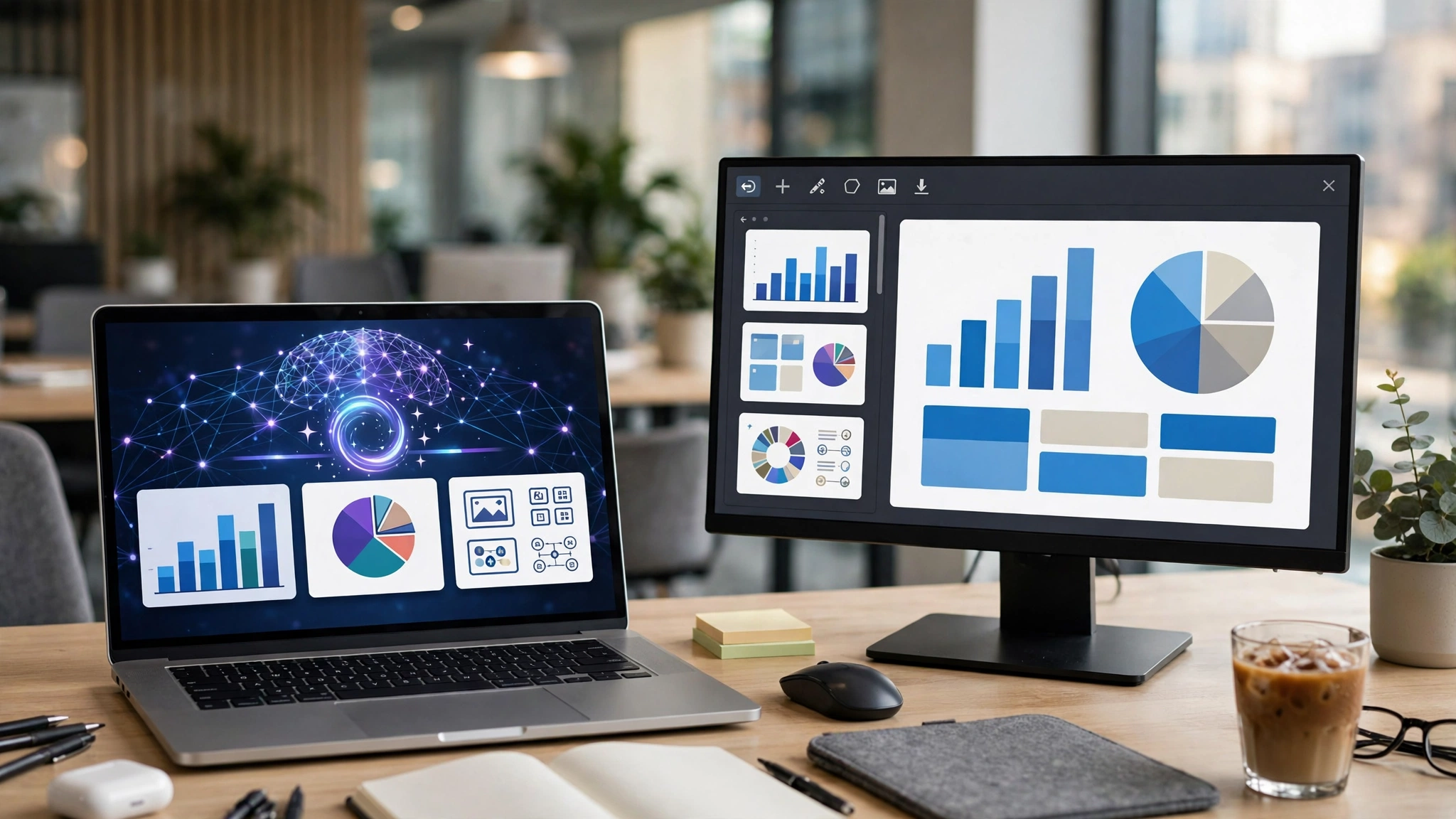
AI replacing PowerPoint and Google Slides is no longer a distant theoretical concept; it is an unfolding reality fundamentally reshaping the future of business presentations. For decades, professionals have spent millions of cumulative hours meticulously tweaking layouts, adjusting fonts, and agonizing over the perfect chart in legacy presentation software. Today, the landscape is shifting from manual slide creation to autonomous generation. However, this transformation brings more than just unprecedented efficiency—it introduces profound ethical dilemmas, corporate security risks, and workflow disruptions.
As we navigate through 2026, organizations are not simply upgrading their software; they are redefining how corporate narratives are constructed and delivered. The transition toward AI presentation tools means that artificial intelligence now dictates pacing, generates visualizations, and even writes the persuasive copy that closes enterprise deals. But is this autonomous efficiency entirely safe? From alarming instances of generative AI hallucinations resulting in financial misrepresentation to illegal copyright infringements hidden within AI-generated graphics, the reality is complex. This comprehensive guide uncovers whether AI replacing PowerPoint and Google Slides is a total displacement or an evolutionary collaboration, highlighting the crucial realities every modern professional must understand.
1. The Core Reality: Is AI Replacing PowerPoint and Google Slides Completely?
When discussing the premise of AI replacing PowerPoint and Google Slides, it is essential to differentiate between complete software replacement and workflow evolution.
Legacy platforms are not vanishing overnight. Instead, the market is experiencing a paradigm shift where AI acts as the foundational creator, while traditional tools serve as collaborative editing environments.
-
The Shift in Time Allocation: In 2023, the average business professional spent upwards of four hours crafting a single presentation. By 2026, the adoption of AI presentation software has compressed this timeline to mere minutes.
-
The Role of Legacy Tools: While AI handles the heavy lifting of structural design, data integration, and initial drafting, platforms like Google Slides remain vital for downstream human collaboration.
-
Autonomous Agents vs. Prompt Interfaces: We have moved beyond simple text-to-slide generators. Modern AI presentation tools act as autonomous agents that analyze target audiences, enforce corporate brand guidelines, and structure complex narratives before a human ever reviews the file.
Therefore, AI replacing PowerPoint and Google Slides is technically an integration rather than a hostile takeover. AI generates the foundation, and human teams refine the output in the environments they already know.
2. The Ethical Minefield and Previous Illegal Activities in AI Presentations
The most critical—and often ignored—aspect of the future of business presentations is the ethical and legal risk associated with automated content generation. While generative AI presentations offer speed, they have historically opened the door to corporate liability.
Data Privacy Breaches and Confidentiality Leaks
In the early days of enterprise AI adoption, several high-profile incidents involved employees feeding proprietary financial data and unreleased product roadmaps into public AI generators to create pitch decks. Because these early models trained on user inputs, highly confidential corporate secrets were inadvertently leaked into the public domain. This illegal exposure of trade secrets forced companies to outright ban unsanctioned AI tools.
Copyright Infringement and Asset Theft
Another stark reality of AI replacing PowerPoint and Google Slides is the generation of unlicensed visual assets. Previous iterations of AI image generators scraped millions of copyrighted artworks, photographs, and proprietary diagrams without consent or compensation. When business professionals used these AI presentation tools to generate graphics for investor pitches and marketing decks, they unknowingly distributed stolen intellectual property. This led to a wave of copyright infringement lawsuits, forcing modern platforms to adopt legally clean, ethically sourced training models.
Hallucinations and Financial Misrepresentation
In a corporate setting, accuracy is non-negotiable. There have been documented cases where AI models hallucinated market statistics and projected false revenue growth within automated sales decks. Presenting fabricated financial data to investors or clients is not just an embarrassing mistake; it borders on corporate fraud. The reality of generative AI presentations demands rigorous human-in-the-loop verification to prevent algorithmic fabrications from becoming corporate policy.
3. The Future of Business Presentations: Adaptive and Context-Aware AI
The future of business presentations is moving rapidly away from static, one-size-fits-all files. As AI replacing PowerPoint and Google Slides becomes the industry standard, the focus has shifted toward hyper-personalized, adaptive content.
Intent-Aware Content Generation
Modern AI presentation software no longer just responds to basic prompts like “make a slide about sales.” In 2026, systems are intent-aware. They analyze the specific context of the meeting. A 10-minute executive summary requires a drastically different tone and pacing than a 60-minute technical training seminar. AI now inherently understands these situational constraints and adjusts the narrative hierarchy accordingly.
Dynamic Audience Personalization
Sales teams are leveraging AI presentation tools to generate uniquely personalized pitch decks for every single prospect. By pulling real-time data from CRMs and external market reports, AI crafts tailored value propositions, customized case studies, and localized data points. This hyper-personalization scales a level of detail that was previously impossible for human teams to manage manually.
4. Top Competitors and the Search for a Google Slides Alternative
As the narrative of AI replacing PowerPoint and Google Slides accelerates, several robust platforms have emerged to claim market dominance. These platforms are not just simple templates; they are comprehensive workflow engines.
-
Presentations.AI: Often touted as the ultimate Google Slides alternative for rapid creation, this platform excels at turning raw documents and outlines into fully branded, animation-ready decks. It solves the “blank slide” problem by generating the heavy design work up front, allowing users to export a flawless
.pptxfile directly into their Google Workspace for final team collaboration. -
Beautiful.ai: Known for its strict adherence to design constraints, Beautiful.ai uses Smart Slide technology to prevent users from making ugly slides. As content is added or removed, the AI automatically readjusts the layout, typography, and spacing to maintain perfect visual hierarchy.
-
Canva Magic Design: By integrating AI seamlessly into its massive design ecosystem, Canva allows users to generate presentations instantly from text prompts, while offering an unparalleled library of legally compliant stock assets and intuitive editing features. (For more on how AI is changing design ecosystems, refer to Canva’s official AI insights).
5. Integrating Generative AI Presentations Safely into Corporate Workflows
To harness the power of generative AI presentations without falling victim to the ethical and legal pitfalls mentioned earlier, organizations must establish strict integration protocols.
Implement Private Model Architectures
To prevent data leaks, enterprise teams must rely on AI presentation software that utilizes closed, private model architectures. This ensures that sensitive internal data uploaded to generate a quarterly earnings deck is never used to train external public models. (Read more about enterprise AI security protocols from Microsoft’s guidelines on AI and data privacy).
Establish Strict Human-in-the-Loop Review
AI replacing PowerPoint and Google Slides does not mean replacing human judgment. Every AI-generated claim, statistic, and financial chart must undergo a mandatory human review cycle. Business leaders must treat AI as a powerful intern—capable of producing incredible first drafts, but requiring an experienced manager to verify the facts before final delivery.
Automated Brand Guardrails
One of the most significant advantages of modern AI presentation tools is the ability to lock down corporate brand identity. By hard-coding hex colors, typography rules, and logo placements into the AI’s generation parameters, companies can ensure that every presentation—regardless of which department generated it—remains perfectly on-brand.
6. The Rise of Video and Asynchronous Presentations
The conversation surrounding AI replacing PowerPoint and Google Slides extends beyond text and images. The future of business presentations is increasingly video-centric.
With the normalization of remote and asynchronous work, static slide decks are often insufficient for communicating complex ideas without a live speaker. Generative AI presentations now routinely feature synthesized voiceovers, synchronized animations, and even AI-generated avatar presenters. This allows sales teams to send highly engaging, self-guided video presentations to prospects, resulting in significantly higher engagement rates than a standard PDF attachment.
7. Strategic Advantages for the Modern Professional
Those who embrace AI presentation software are gaining a massive competitive edge. The ability to generate a structurally sound, beautifully designed, and highly persuasive presentation in ten minutes allows professionals to reallocate their time toward strategy, rehearsal, and relationship building.
AI replacing PowerPoint and Google Slides in the initial drafting phase eliminates the friction of formatting, allowing the human presenter to focus entirely on the delivery of the message. Ultimately, the software you use matters less than the story you tell, and AI is simply the newest, most efficient tool for outlining that story.
Conclusion
The debate over AI replacing PowerPoint and Google Slides is fundamentally settled: AI is not entirely erasing these legacy platforms, but it has irreversibly transformed how they are used. The future of business presentations belongs to hybrid workflows where generative AI presentations handle the laborious tasks of drafting, designing, and data structuring, while platforms like Google Slides facilitate final human collaboration. However, as we have seen from past ethical breaches and illegal asset usage, this technology demands responsible oversight. By leveraging intent-aware AI presentation tools and maintaining strict factual verification, businesses can unlock unprecedented efficiency without compromising their integrity or security.
Follow Us