US vs Iran War: Comparing Weapons, Drones, and Defense Systems
US vs Iran war breakdown — comparing missiles, drones, fighter jets, naval power, and defense systems to see who holds the real military edge in 2025–2026.
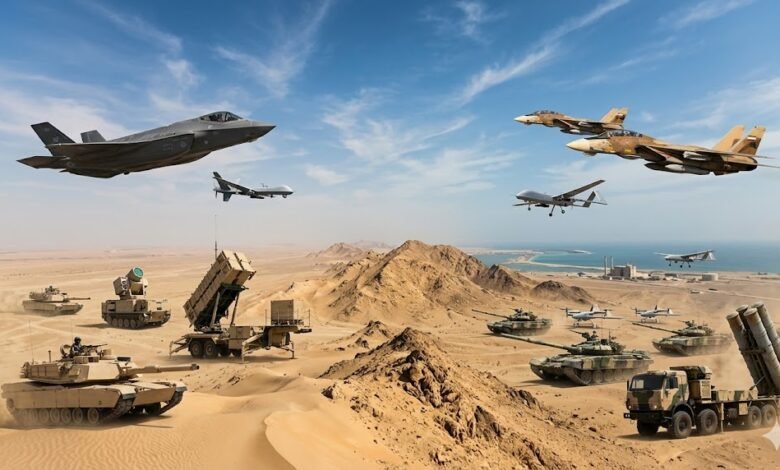
The US vs Iran war scenario has been a topic of serious strategic debate for decades. From the 1979 hostage crisis to the 2020 killing of General Qasem Soleimani, tensions between Washington and Tehran have repeatedly brought the two nations to the edge of open conflict. While a full-scale war has never materialized, both sides have invested heavily in preparing for one.
The United States operates the most well-funded and technologically advanced military on the planet. Iran, by contrast, has built an asymmetric war machine — one designed not to match American power head-on, but to bleed it through unconventional tactics, proxy networks, and homegrown weapons.
What makes this comparison genuinely interesting is that it is not a simple story of a superpower versus a pushover. Iran has developed ballistic missiles, advanced drone fleets, anti-ship weapons, and sophisticated cyber warfare capabilities that pose real challenges to American forces. At the same time, the gap in air power, naval tonnage, defense systems, and overall military spending remains enormous.
This article breaks down both sides across every major military category — air power, ground forces, naval capabilities, drones, missile arsenals, and missile defense — to give you a clear, honest picture of where each country stands.
US vs Iran War: The Core Military Imbalance
Before diving into specific systems, it helps to understand the scale difference.
The United States defense budget in 2024 was approximately $886 billion, making it larger than the next nine countries combined. Iran’s official defense budget hovers around $10–15 billion annually, though actual spending is difficult to verify due to funds routed through the Islamic Revolutionary Guard Corps (IRGC).
That said, money alone does not tell the whole story. Iran has spent decades preparing specifically for a conflict with the US, building capabilities tailored to that one scenario. Its military doctrine prioritizes denial, disruption, and cost imposition over outright victory.
Military Budget and Manpower
| Category | United States | Iran |
|---|---|---|
| Defense Budget | ~$886 billion | ~$10–15 billion |
| Active Personnel | ~1.3 million | ~525,000 |
| Reserve Forces | ~800,000 | ~350,000+ |
| Paramilitary (IRGC/Basij) | N/A | ~150,000+ |
Iran compensates for budget shortfalls through proxy warfare — supporting Hezbollah, Houthi rebels, and various Iraqi militias to extend its reach without direct military confrontation.
Air Power Comparison: F-35 vs Aging Iranian Jets
This is where the gap becomes most apparent. The US Air Force fields some of the most advanced aircraft ever built. Iran’s air force, on the other hand, is largely a relic of the pre-revolution era, supplemented by Russian and domestically produced equipment.

US Air Power
The United States operates:
- F-35 Lightning II — fifth-generation stealth multirole fighter with advanced sensor fusion
- F-22 Raptor — the gold standard of air superiority, with supercruise capability and extreme stealth
- B-2 Spirit and B-21 Raider — long-range stealth bombers capable of striking targets deep inside Iran
- F-15EX Eagle II — upgraded air superiority and strike platform
- A-10 Thunderbolt II — close air support specialist
- Over 13,000 aircraft across all branches
Iranian Air Power
Iran operates an aging fleet that includes:
- F-14 Tomcats — purchased before 1979, now difficult to maintain without US spare parts
- MiG-29 Fulcrums — acquired from Russia in the 1990s
- Su-24 Fencers — Soviet-era strike aircraft
- HESA Kowsar — Iran’s domestically produced fighter jet, largely considered a light combat aircraft
- Approximately 350–500 fixed-wing aircraft in total, with questionable operational readiness
In a direct air-to-air conflict, Iran’s air force would be outmatched within days. The real threat Iran poses from the sky comes not from its jets but from its drone and missile programs.
Iranian Drone Capabilities: A Genuine Threat
Iran’s drone program is arguably its most significant military development of the past decade. The country has invested heavily in unmanned aerial vehicles (UAVs), and the results have been exported to conflicts across the Middle East — and, controversially, to Russia’s war in Ukraine.
The Shahed Family
The Shahed-136 — known in Ukraine as the “Geran-2” — is a one-way attack drone that functions more like a loitering munition. It is cheap to produce, difficult to detect on radar due to its small profile, and can be launched in swarms to overwhelm air defenses.
Key specs:
- Range: approximately 2,000–2,500 km
- Warhead: roughly 50 kg
- Cost: estimated $20,000–$50,000 per unit
- Guidance: GPS and inertial navigation
The Shahed-149 Gaza is a larger, longer-range variant with a heavier payload. Iran has also developed the Mohajer-6 and Ababil series for reconnaissance and strike missions.
Why This Matters for US Forces
American carriers, bases, and logistics hubs in the Persian Gulf region would face real threats from massed drone attacks. When Iran launched over 300 drones and missiles at Israel in April 2024, the attack was intercepted successfully — but it demonstrated Iran’s willingness and ability to execute large-scale aerial assaults. Against US facilities spread across Bahrain, Qatar, and Kuwait, a similar campaign would stretch air defense resources.
The cost asymmetry is also significant. Shooting down a $50,000 Shahed drone with a $3–4 million Patriot interceptor missile is not economically sustainable over a long campaign.
US Drone and Unmanned Systems
The United States leads the world in military drone technology, both in sophistication and operational experience.
Key US Drone Platforms
- MQ-9 Reaper — the workhorse of US drone warfare, capable of carrying Hellfire missiles and GBU-12 bombs with 27+ hours of endurance
- RQ-4 Global Hawk — high-altitude, long-endurance surveillance drone
- MQ-4C Triton — naval surveillance variant
- RQ-170 Sentinel — stealth reconnaissance drone
- MQ-25 Stingray — carrier-based refueling drone, extending carrier air wing range
The US also operates the Switchblade family of loitering munitions, and is actively developing autonomous drone swarms through programs like the Collaborative Combat Aircraft (CCA) initiative.
Iran famously captured a RQ-170 Sentinel in 2011, which Tehran claims helped it reverse-engineer aspects of US drone technology. That incident provided a genuine intelligence windfall.
Missile Arsenals: Iran’s Most Credible Deterrent
If drones are Iran’s calling card, ballistic and cruise missiles are its most dangerous conventional weapon. Iran has built the largest and most diverse missile arsenal in the Middle East, specifically designed to deter US intervention and threaten regional US bases.
Iranian Missile Systems
Ballistic Missiles:
- Shahab-3 — medium-range ballistic missile, range ~1,300 km, based on North Korean Nodong design
- Emad — precision-guided variant with maneuverable warhead, range ~1,700 km
- Khorramshahr-4 — Iran’s most advanced MRBM, claimed range of 2,000 km with multiple warheads
- Fattah — Iran’s claimed hypersonic glide vehicle, announced in 2023, with a reported range of 1,400 km
Cruise Missiles:
- Ya Ali — air-launched cruise missile with terrain-following guidance
- Hoveizeh — ground-launched cruise missile, range 1,350+ km
Anti-Ship Missiles:
- Noor and Qader — subsonic anti-ship missiles
- Khalij Fars — ballistic anti-ship missile, designed specifically to target US aircraft carriers
Iran’s October 2024 missile strike on Israel used Fattah and Emad variants, giving Western analysts their most detailed look yet at the accuracy and penetration capabilities of Tehran’s advanced missiles. Several warheads reportedly reached their targets despite Israeli and US interception efforts.
US Missile Arsenal
The US fields an overwhelming range of precision strike weapons:
- Tomahawk cruise missile — 1,600+ km range, extreme precision, launched from ships and submarines
- JASSM-ER — air-launched stealth cruise missile, range 925+ km
- LRASM — long-range anti-ship missile
- AGM-158D JASSM-XR — extended-range variant under development
- Trident II D5 — submarine-launched ballistic missile (nuclear)
In a conventional conflict, the US would open any campaign with long-range precision strikes from outside Iranian air defense range — making Iranian air defenses the first priority target.
Naval Power: Persian Gulf Dominance vs Asymmetric Harassment
The Persian Gulf is the most likely theater of a US-Iran conflict, and both sides have built their naval strategies around it.
US Naval Forces in the Region
The US 5th Fleet, headquartered in Bahrain, maintains a persistent presence in the Gulf. Typical assets include:
- Aircraft carrier strike groups — with up to 90 aircraft and escort vessels
- Arleigh Burke-class destroyers — equipped with Aegis combat systems and Standard Missiles
- Virginia-class submarines — stealthy, nuclear-powered attack submarines
- Littoral Combat Ships — fast, shallow-draft vessels for Gulf operations
The US Navy has total naval tonnage exceeding 4.5 million tons compared to Iran’s approximately 90,000 tons.
Iranian Naval Strategy
Iran does not attempt to match the US Navy ship-for-ship. Instead, the IRGC Navy employs a swarm boat doctrine — using large numbers of fast attack craft to overwhelm larger US vessels in confined Gulf waters.
Key Iranian naval assets include:
- Ghadir-class midget submarines — small, hard to detect in shallow Gulf waters
- Fateh-class submarines — domestically built, armed with torpedoes and mines
- Fast attack craft with rocket launchers and anti-ship missiles
- Naval mines — Iran is believed to have an extensive mine stockpile capable of disrupting Gulf shipping
The Strait of Hormuz — the 21-mile-wide chokepoint through which roughly 20% of the world’s oil passes — is Iran’s ultimate leverage point. Mining or blocking it would have catastrophic global economic consequences and represents a genuine deterrent option.
Defense Systems: THAAD and Patriot vs Iran’s Air Defenses
US Missile Defense
The United States has layered, redundant missile defense covering the region:
- THAAD (Terminal High Altitude Area Defense) — intercepts ballistic missiles in their terminal phase at high altitude; deployed to Saudi Arabia, UAE, and Israel-adjacent positions
- Patriot PAC-3 — lower-tier interceptor, proven in combat across multiple conflicts
- Aegis BMD — ship-based ballistic missile defense, covering naval groups and regional targets
- Iron Dome (operated by Israel, US-funded) — effective against short-range rockets and artillery shells
In April 2024, US destroyers fired Standard Missile-3 interceptors and directly assisted Israel in neutralizing Iranian drones and ballistic missiles — the first time the US directly intercepted Iranian munitions in combat.
Iranian Air Defense
Iran has invested significantly in its air defenses, though gaps remain:
- S-300PMU-2 — Russian-supplied long-range surface-to-air missile system, capable against aircraft and some cruise missiles
- Bavar-373 — Iran’s domestically developed equivalent to the S-300, announced as operational in 2019
- Khordad-3 and Khordad-15 — medium-range SAM systems; the Khordad-3 reportedly shot down a US RQ-4A Global Hawk in 2019
- Raad and Talash — domestically produced SAMs of varying ranges
The weakness in Iran’s air defense is coverage depth and integration. US stealth aircraft like the F-22, F-35, and B-21 are designed specifically to penetrate systems like the S-300 and Bavar-373. A US strike campaign would use stealth aircraft to degrade these defenses before conventional forces enter the picture.
Cyber Warfare Capabilities
Both nations have invested heavily in offensive cyber capabilities, and this domain could play a major role in any conflict.
The United States Cyber Command (USCYBERCOM) is one of the most capable cyber warfare organizations in the world. The US (along with Israel) is widely credited with developing Stuxnet — the cyberweapon that sabotaged Iranian uranium enrichment centrifuges at Natanz in the early 2010s. This remains the most consequential offensive cyber operation ever publicly attributed.
Iran responded by building up its own cyber capabilities, attributed to groups like APT33, APT34, and the IRGC’s cyber division. Iranian hackers have:
- Disrupted Saudi Aramco’s network with the Shamoon malware
- Conducted intrusion campaigns against US financial institutions
- Targeted US critical infrastructure networks
- Conducted election interference and disinformation operations
In a US vs Iran conflict, cyber operations would likely run parallel to kinetic strikes — targeting power grids, communications infrastructure, and military command systems on both sides. Iran’s cyber capabilities are a genuine force multiplier that compensate for its conventional disadvantages. For deeper context on Iran’s cyber operations, the Council on Foreign Relations’ tracker on state-sponsored cyber operations provides comprehensive documentation.
Space and Intelligence Assets
The US advantage in space-based intelligence, surveillance, and reconnaissance (ISR) is enormous. GPS-guided munitions, satellite communications, signals intelligence collected by the NSA, and real-time imagery from a constellation of military and intelligence satellites all give American commanders a comprehensive battlefield picture that Iran simply cannot match.
Iran has launched its own military satellites — the IRGC placed the Noor satellite into orbit in 2020 — but its space-based capabilities remain rudimentary by comparison. Iran’s primary ISR assets are ground-based radar networks and the drone surveillance platforms it has developed domestically.
According to the International Institute for Strategic Studies’ Military Balance, Iran’s satellite and reconnaissance capabilities lag significantly behind the US, though they have improved substantially over the past decade.
Proxy Forces and Strategic Depth
One area where Iran genuinely complicates any US military calculation is its network of proxy forces across the region. These include:
- Hezbollah in Lebanon — arguably the most capable non-state armed actor in the world, with over 150,000 rockets aimed at Israel
- Houthi rebels in Yemen — demonstrated ability to strike Saudi Arabia and disrupt Red Sea shipping
- Kata’ib Hezbollah and PMF factions in Iraq — capable of targeting US bases with drones and rockets
- Hamas in Gaza — politically aligned with Iran despite some tactical distance
In a full-scale US-Iran war, these groups would activate simultaneously, forcing US and allied forces to respond on multiple fronts. This is the foundation of Iran’s forward defense doctrine — fighting the US “outside its borders” through surrogates rather than waiting to absorb attacks at home.
Ground Forces and Urban Warfare Capacity
US Ground Forces
The US Army and Marine Corps field:
- M1A2 Abrams tanks — among the most advanced in the world
- Bradley and Stryker infantry fighting vehicles
- Apache attack helicopters for close air support
- Special Operations Forces (Green Berets, Navy SEALs, Rangers) with extensive counterinsurgency experience
Iranian Ground Forces
Iran’s ground forces are large but rely on older equipment:
- T-72 and T-55 tanks — Russian and Soviet-era designs
- Zulfiqar and Karrar — domestically produced MBTs with mixed reviews on actual performance
- Artillery and rocket systems in large numbers
- A well-trained IRGC Quds Force specialized in unconventional warfare
Iran’s biggest ground force advantage would come in a scenario where US troops were fighting inside Iran — a deep invasion. The country’s terrain (mountain ranges, urban centers, deserts) is extraordinarily difficult for conventional military operations. The lesson of Iraq and Afghanistan applies: winning the conventional war is one thing; pacifying a country of 88 million people is another entirely.
How a US-Iran Conflict Would Likely Unfold
Based on the military comparison above, a realistic US-Iran war scenario would likely proceed in phases:
- Phase 1 — Missile and Drone Exchanges: Iran launches preemptive strikes against US bases in Bahrain, Qatar, Kuwait, and possibly UAE. US responds with Tomahawk strikes and stealth aircraft targeting Iranian air defenses, command centers, and missile storage.
- Phase 2 — Air Campaign: With Iranian air defenses degraded, the US establishes air superiority and begins systematic destruction of missile launch facilities, naval assets, nuclear sites, and IRGC infrastructure.
- Phase 3 — Naval and Strait Conflict: Iran attempts to mine or block the Strait of Hormuz. US Navy and coalition partners clear mines and suppress Iranian fast boat swarms, likely at significant cost.
- Phase 4 — Proxy Escalation: Hezbollah, Houthis, and Iraqi militias escalate attacks across the region, dragging in Israel, Saudi Arabia, and other US partners.
- Phase 5 — Endgame: A full-scale US ground invasion of Iran is almost certainly off the table politically and logistically. The most likely outcome is a negotiated ceasefire following significant damage to Iran’s military infrastructure, with neither side achieving a decisive strategic victory.
Conclusion
The US vs Iran war comparison makes one thing clear: the United States holds an overwhelming advantage in almost every conventional military category — air power, naval strength, missile precision, defense systems, and intelligence assets. But Iran has spent decades building a toolkit specifically designed to make that advantage costly to use. Its drone swarms, ballistic missile arsenal, proxy networks, and asymmetric naval tactics in the Persian Gulf ensure that any conflict would be damaging and unpredictable for both sides. The US would almost certainly “win” a conventional exchange, but controlling the aftermath — and containing the regional escalation through Iran’s proxies — would present a far harder challenge than the initial military campaign. That is precisely why, despite decades of tension, both sides have repeatedly stepped back from the edge.