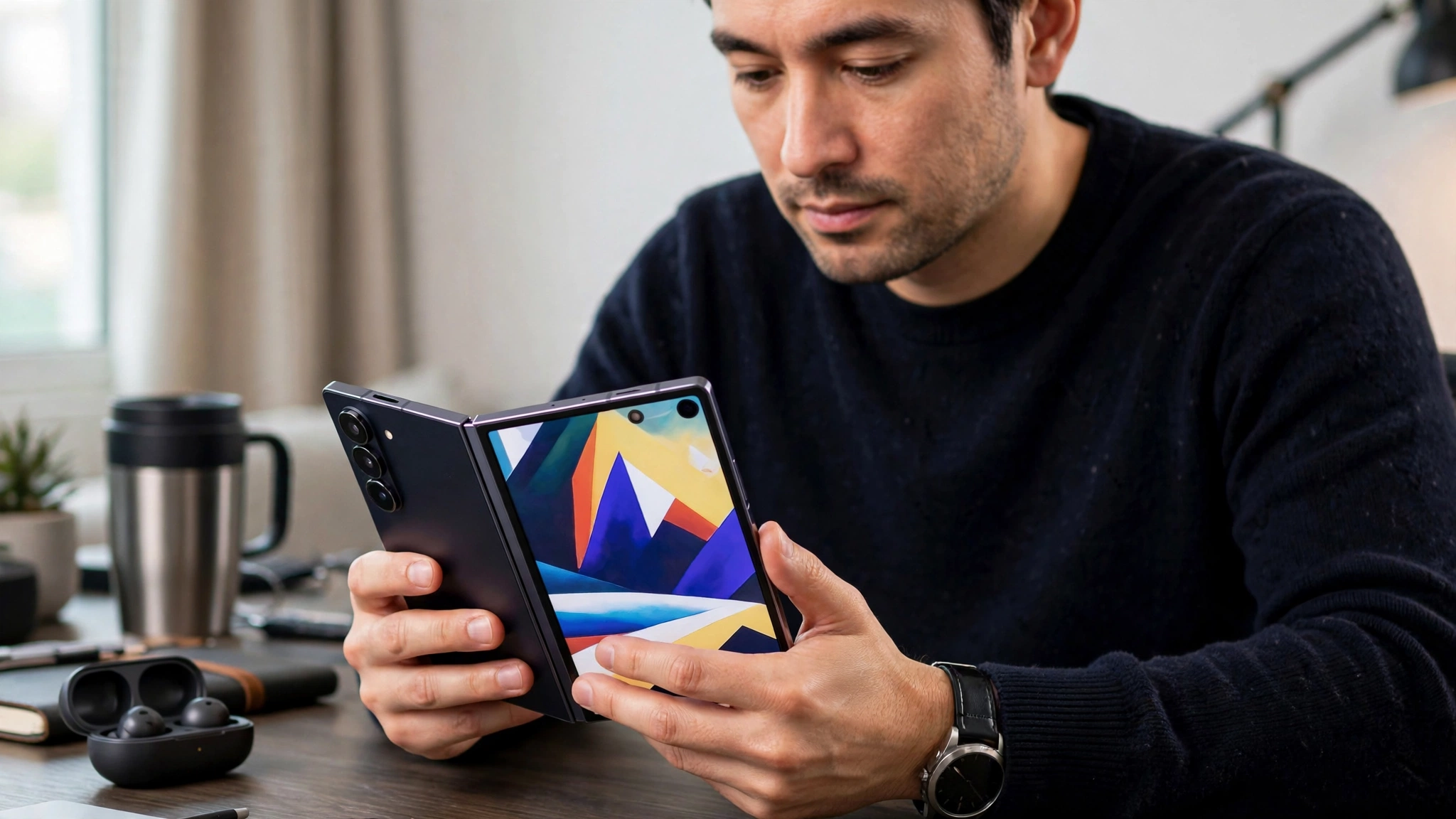
The Samsung Galaxy Z Fold8 Ultra is the phone that finally answers the question a lot of foldable fans have been asking for two years: what happens when Samsung stops playing it safe? After a few generations of small, cautious updates, the Galaxy Z Fold8 Ultra shows up with a genuinely bigger battery, faster charging, a sharper inner screen, and a camera system that borrows heavily from the Galaxy S26 Ultra. It also takes over the “Ultra” spot in Samsung’s foldable lineup, sitting above the shorter, wider standard Z Fold8 that’s aimed more at media and casual use.
If you’ve used a Z Fold before, you already know the pitch: a phone that unfolds into something close to a small tablet, built for people who juggle emails, spreadsheets, and video calls without wanting to carry a separate device. What’s changed this year is how much friction Samsung has removed from that experience. The crease is less noticeable, the screen is brighter outdoors, the battery actually gets you through a full day of heavy use, and the software leans harder into multitasking and Galaxy AI than any previous Fold.
In this review, we’ll walk through the design, display, performance, cameras, battery life, and pricing of the Samsung Galaxy Z Fold8 Ultra, then compare it against its closest rivals so you can decide whether it’s worth the jump. We’ll also cover who this phone actually makes sense for, because at this price, it’s not for everyone.
What Is the Samsung Galaxy Z Fold8 Ultra?
The Galaxy Z Fold8 Ultra is Samsung’s flagship book-style foldable for 2026, and it effectively replaces the Z Fold7 as the top-tier option in the Fold family. Samsung split its foldable lineup this year into three distinct products: the Galaxy Z Flip8 for quick, pocketable use, the standard Galaxy Z Fold8 with a wider, shorter shape built for scrolling and video, and the Z Fold8 Ultra, which keeps the more traditional Fold proportions and pushes further into productivity and content creation.
Here’s a quick look at the core specs:
- Display: 8.0-inch foldable LTPO AMOLED main screen, 120Hz, 3000 nits peak brightness, with a 6.5-inch cover display
- Chipset: Snapdragon 8 Elite Gen 5 for Galaxy (3nm)
- RAM/Storage: Up to 16GB RAM and 1TB storage
- Rear cameras: 200MP main, 50MP ultrawide, 10MP telephoto with 3x optical zoom
- Battery: 5000mAh with 45W wired and 20W wireless charging
- Software: Android 17 with One UI 9, promised for 7 major OS updates
- Build: Gorilla Glass Victus Ceramic 3 front, Advanced Armor aluminum frame, IP48 rating
On paper, this is a meaningful jump over the Z Fold7, not just a name change with a bigger price tag.
Design and Build Quality

Samsung had a real challenge here: add tougher materials and a bigger battery without making the phone thicker or heavier. It mostly pulled it off. The Z Fold8 Ultra measures 158.4 x 143.2 x 4.1mm when unfolded and weighs 215g, keeping it in line with its predecessor despite the internal upgrades.
What’s New in the Build
The frame now uses what Samsung calls Advanced Armor aluminum, paired with Gorilla Glass Victus Ceramic 3 on the front and Gorilla Glass Victus 2 on the back. The hinge mechanism has been refined again, and the crease on the inner display is noticeably less visible than on the Z Fold7, both to the eye and under your thumb.


The phone carries an IP48 rating, meaning it’s protected against dust particles larger than 1mm and can survive submersion up to 1.5 meters for 30 minutes. That’s a step up in dust resistance from most foldables on the market, though it still falls short of the full dust resistance you’d get on a standard slab phone.
Handling in Daily Use
Folded up, it behaves like a slightly thick but manageable phone. Unfolded, it’s genuinely tablet-like, which is either the whole appeal or the main drawback depending on how you use your phone. One-handed typing on the cover screen is fine; one-handed use of the unfolded 8-inch display is not really practical, and that’s true of every book-style foldable, not just this one.
Display: Bigger, Brighter, Smoother

This is where the Samsung Galaxy Z Fold8 Ultra makes its most convincing case. The inner display is an 8.0-inch Dynamic LTPO AMOLED 2X panel running at 120Hz, with a resolution of 2256 x 2504 pixels and a peak brightness of 3000 nits. Samsung added an anti-reflective coating this generation, which makes a real difference when you’re trying to read or work outdoors.
Cover Screen Improvements
The cover display grew to 6.5 inches, also running at 120Hz with the same LTPO AMOLED 2X technology and Gorilla Glass Ceramic 3 protection. It’s sharp enough and fast enough that a lot of daily tasks like replying to messages or checking notifications don’t require unfolding the phone at all.
Why the Crease Matters Less Now
Samsung’s Flex Titanium hinge technology and the redesigned internal layers have reduced the crease’s visibility and depth. It hasn’t disappeared, and if you’re coming from a flat-screen phone you’ll still notice it in certain lighting, but longtime Fold users will find it a clear improvement over the Z Fold7.
Performance and Software
Under the hood, the Z Fold8 Ultra runs on the Snapdragon 8 Elite Gen 5 for Galaxy, built on a 3nm process. Paired with up to 16GB of RAM, it handles multitasking, gaming, and heavier productivity apps without much strain. Storage options run from 256GB up to 1TB, which matters more on a phone likely to be used for content creation and desktop-style work.
One UI 9 and Android 17
The Galaxy Z Fold8 Ultra ships with Android 17 and One UI 9 right out of the box, making it one of the first phones to launch with Google’s latest Android version pre-installed. Samsung is backing that up with a promise of 7 major OS upgrades, which is a genuinely strong commitment in a market where software longevity varies wildly between brands.
Galaxy AI and Multitasking
Samsung leaned further into Galaxy AI this generation, with features that suggest relevant apps based on what you’re doing and let you view multiple windows side by side on the large inner screen. Some of these AI features work with select apps and require a Samsung account, and more advanced AI tools may come with separate fees, so it’s worth checking exactly what’s included before assuming everything is free.
Samsung DeX support is also onboard, letting you connect the phone to a monitor for a desktop-style experience, along with USB video output, which is handy if you actually plan to use this as a laptop replacement in a pinch.
Camera Performance
The rear camera system is one of the clearer upgrades over the Z Fold7. You get a 200MP main sensor (f/1.7) with optical image stabilization, a 50MP ultrawide lens (f/1.9) that’s a genuine step up from previous Fold ultrawide cameras, and a 10MP telephoto lens (f/2.4) offering 3x optical zoom.
Photo Quality
In good lighting, the main sensor produces sharp, detailed shots with accurate colors, and the improved ultrawide brings the Z Fold8 Ultra noticeably closer to the image quality of the Galaxy S26 Ultra. Low-light performance is solid, though it’s not quite at the very top of the market.
Where It Falls Short
The telephoto camera is the weak point. At 10MP with 3x zoom, it’s usable but doesn’t hold up as well against some rivals that pack in higher-resolution zoom lenses. If zoom photography matters a lot to you, this is worth testing in person before you buy.
Video and Front Cameras
Video capture goes up to 8K at 30fps on the rear cameras, with 4K available at up to 120fps for smoother slow-motion footage. Both the cover and main screen host 10MP front cameras, and features like Dual Recording let you capture footage from both sides of the phone at once, which is genuinely useful for interviews or reaction-style content.
Battery Life and Charging

Battery has historically been a sore spot for the Z Fold series, and Samsung made real progress here. The Galaxy Z Fold8 Ultra packs a 5000mAh battery, up from 4400mAh on the Z Fold7, a roughly 14% increase made possible partly by switching to a silicon-carbon battery design that improves energy density without adding weight.
Charging Speeds
Wired charging jumps to 45W, up from the 25W that Fold users were stuck with for several generations, getting the phone to about 67% in 30 minutes. Wireless charging supports 20W over Qi2.2, and there’s 4.5W reverse wireless charging for topping up earbuds or a watch.
Real-World Battery Life
In practice, the bigger battery and more efficient chipset combine to get most users through a full day of moderate to heavy use. It’s a clear improvement, though a few competitors still edge it out in outright endurance, which we’ll cover in the comparison section below.
Samsung Galaxy Z Fold8 Ultra Price and Availability
Pricing is where the Z Fold8 Ultra asks a lot of its buyers. It starts at $2,100 for the base 256GB/12GB configuration, climbing higher for the 512GB and 1TB models with 16GB of RAM. That’s roughly 20 to 30 percent more than several of its closest rivals, and it puts the phone firmly in premium flagship territory, well above even most non-folding flagships.
Despite the price, Samsung reportedly saw record pre-orders for the Z Fold8 Ultra alongside the standard Z Fold8 and Flip8, suggesting brand loyalty and the improved feature set are enough to justify the cost for a lot of buyers. For the latest official pricing and configurations, it’s worth checking Samsung’s official Galaxy Z Fold8 Ultra product page directly, since carrier deals and trade-in credits can shift the effective price quite a bit.
Samsung Galaxy Z Fold8 Ultra vs the Competition
This is the part of the review where things get interesting, because the Z Fold8 Ultra isn’t winning every category anymore.
Honor Magic V6
The Honor Magic V6 is arguably the biggest threat here. It offers a better camera experience, a larger battery, and an arguably more durable chassis, all while retailing for around €1,700, noticeably less than the Z Fold8 Ultra. If Honor’s availability in your region is solid, it’s genuinely worth cross-shopping.
Motorola Razr Fold
The Motorola Razr Fold takes better stills in side-by-side testing and lasts longer on a single charge, while also undercutting the Z Fold8 Ultra by around $200 and offering twice the storage at the base tier.
Oppo Find N6
The Oppo Find N6 beats the Z Fold8 Ultra in both battery life and charging speed, and adds a larger, more feature-rich display with Dolby Vision support and stylus compatibility, all at a lower price point.
vivo X Fold6
The vivo X Fold6 offers longer battery life and slightly faster charging, with improved camera hardware expected to make it a strong option, particularly in markets like India where vivo has a solid foothold.
Samsung Galaxy Z Fold8 (Standard)
If you don’t need the telephoto lens or the slightly larger main sensor, the standard Z Fold8 is $200 cheaper and offers a shorter, wider form factor that some people find more comfortable for media consumption and gaming, even if it’s a bit less ideal for serious productivity work.
Samsung Galaxy Z Fold7
The outgoing Z Fold7 is now around €900 cheaper. You’ll miss out on the improved battery, faster charging, and the brighter, less creased display, but if budget is the main concern, it’s still a capable foldable.
For an independent, hands-on breakdown of how these numbers held up in lab testing, GSMArena’s full Galaxy Z Fold8 Ultra review is worth reading alongside this one.
Pros and Cons
Pros
- Thin, lightweight design despite tougher materials
- Improved inner display with less crease, anti-reflective coating, and higher resolution
- Strong main camera performance
- Finally competitive 45W fast charging
- Noticeably better battery life than the Z Fold7
- Feature-rich software with genuinely useful multitasking and Galaxy AI tools
- Launches on Android 17/One UI 9 with 7 years of major OS updates promised
- Solid video recording features, DeX support, and USB video output
Cons
- Battery life, while improved, still trails several competitors
- Speakers sound worse than on the previous generation
- Telephoto camera is underwhelming compared to rivals
- Price sits well above most competing foldables
Who Should Buy the Samsung Galaxy Z Fold8 Ultra?
This phone makes the most sense for people already inside the Samsung ecosystem who use their phone heavily for work, whether that’s managing email and documents, running multiple apps side by side, or occasionally plugging into a monitor with DeX. It’s also a strong pick for anyone who wants a big screen for content creation, thanks to the improved camera system and video features.
If you’re mainly after the best possible camera, the longest battery life, or the lowest price in the foldable category, the Honor Magic V6, Motorola Razr Fold, or Oppo Find N6 deserve a serious look before you commit. And if you already own a Z Fold7, the upgrade is nice to have but not essential unless the battery and display improvements specifically solve problems you’ve been running into.
Conclusion
The Samsung Galaxy Z Fold8 Ultra is a real step forward for Samsung’s foldable lineup, bringing a brighter and less creased display, a noticeably bigger battery, much faster charging, and a camera system that finally starts to close the gap with Samsung’s own S26 Ultra. It launches with the latest Android 17 and One UI 9, backed by a strong seven-year update promise, and the added Galaxy AI features make multitasking on that big inner screen genuinely more useful than before. That said, the competition hasn’t stood still, and rivals like the Honor Magic V6 and Oppo Find N6 beat it on battery life, camera performance, or price, sometimes all three at once. If you value Samsung’s software support, ecosystem, and productivity tools, the Z Fold8 Ultra is one of the most complete foldables you can buy right now, but it’s worth comparing prices and specs against the alternatives before you spend this much on a phone.