7 Loan App Scams in Pakistan: Dangerous Warning Signs and How to Avoid Them
Loan app scams in Pakistan are rising fast. Here's how these fraudulent apps operate, the red flags to watch for, and how to protect yourself.
Getting money fast has never been easier, or riskier, than it is right now on your phone. Over the last few years, loan app scams in Pakistan have grown from a niche complaint into a nationwide problem that regulators, journalists, and law enforcement can barely keep up with. What starts as a simple ad promising quick cash with “no paperwork” often ends with someone’s contacts and photos in the hands of a stranger who calls their relatives, coworkers, and neighbors to demand repayment on inflated terms they never agreed to.
The State Bank of Pakistan, the Securities and Exchange Commission of Pakistan (SECP), and the Federal Investigation Agency (FIA) have all taken action against these apps, removing hundreds from app stores and blacklisting dozens of operators. Yet new ones keep appearing under different names, often distributed outside official app stores where oversight is weakest.
This article walks through how these scams actually work, the warning signs that separate a legitimate digital lender from a predatory one, and the practical steps you can take before you ever tap “apply now.” If you or someone you know has already fallen into this trap, we’ll also cover exactly where to report it and how to start undoing the damage.
What Are Loan App Scams in Pakistan?
Loan app scams in Pakistan refer to mobile applications, often disguised as legitimate microfinance or digital lending platforms, that lure users with promises of instant, low-interest, paperless loans. Once installed, these apps request far more access than any lender needs, harvest personal data, and then use that data as leverage once the loan comes due.
Unlike traditional lenders regulated by the SBP or licensed as Non-Banking Financial Companies (NBFCs) under SECP, most of these apps operate without any real license. Some copy the branding of legitimate financial services to appear trustworthy. Others simply vanish and reappear under a new name once regulators catch up to them, a pattern that has made enforcement an ongoing chase rather than a one-time fix.
Why Loan App Scams Are Spreading Across Pakistan
A few conditions have made Pakistan particularly fertile ground for fraudulent lending apps:
- Rising cost of living. Inflation has pushed many households toward informal borrowing, and these apps position themselves as a faster alternative to banks.
- Low financial literacy around digital lending. Many first-time borrowers don’t know what a legitimate NBFC license looks like or that one is even required.
- Easy app distribution. Even after Google and Apple remove an app, operators simply distribute the same app as an APK file through WhatsApp groups, Facebook ads, or third-party websites, bypassing app store review entirely.
- Weak, still-developing data protection law. Pakistan’s Personal Data Protection Bill has been in draft form for years, leaving a legal gap that scam operators exploit to justify collecting and misusing personal data.
- Slow cross-border accountability. Some operations are linked to networks and call centers operating outside Pakistan, which complicates prosecution even when a scam is clearly identified.
How Loan App Scams in Pakistan Actually Work
Understanding the mechanics behind these schemes makes it much easier to spot one before you hand over your data.
Fake Registration and Copycat Branding
Many scam apps either claim a registration they don’t have or copy the look and name of a real, licensed NBFC closely enough that a rushed borrower won’t notice the difference. Some go as far as using slightly altered spellings of legitimate company names or fake SECP certificate numbers displayed inside the app.
Excessive Permission Requests
This is the single biggest giveaway. Legitimate, SECP-licensed digital lending apps are barred from accessing your contact list or photo gallery. Scam apps, on the other hand, almost always ask for full access to contacts, photos, call logs, and sometimes even SMS messages, well beyond anything needed to process a loan application. This data becomes the primary tool used to pressure borrowers later.


Hidden Charges and Inflated Markup
The advertised interest rate is rarely what borrowers actually pay. Processing fees, “insurance” charges, and penalty clauses buried in fine print routinely push the real cost of the loan far above what was promised at signup. Some victims report being told they owe two or three times the original loan amount within days of disbursement.
Harassment and Blackmail Tactics
Once a payment is late, even by a single day, some operators shift from customer service to intimidation. Reported tactics include mass messages sent to the borrower’s saved contacts, doctored images, threatening phone calls, and in the most extreme documented cases, psychological pressure severe enough to contribute to tragic outcomes. FIA officials have publicly described dedicated “harassment call cells” set up by some of these operations specifically to pressure defaulters.
Warning Signs of a Fraudulent Loan App
Before downloading any lending app, run through this checklist:
- No SECP registration number, or a number that can’t be verified on the SECP website.
- Requests access to contacts, gallery, or SMS during installation.
- Loan approval within minutes with no credit check or documentation at all.
- Vague or missing Key Fact Statement (KFS) outlining fees, interest, and repayment tenor before disbursement.
- Pressure tactics in the app’s own messaging, such as countdown timers or aggressive “apply now” pop-ups.
- Distributed only as an APK file through WhatsApp or a website rather than an official app store.
- Poor or suspiciously generic reviews, often flooded with either five-star ratings posted the same week or a wave of recent complaints about harassment.
- No verifiable customer service number or physical office address.
If an app checks two or more of these boxes, treat it as a red flag and look elsewhere.
How Regulators Are Responding
Pakistani authorities have not ignored this problem, even if enforcement remains a constant back-and-forth. The SECP maintains a whitelist of approved digital lending apps and has removed well over a hundred illegal apps from app stores in recent years, with dozens more formally blacklisted. The State Bank of Pakistan issued circulars instructing banks, microfinance institutions, and payment service providers to stop processing transactions for unlicensed digital lenders, cutting off the banking channels these apps rely on for disbursement and collection.
The FIA’s Cybercrime Wing has run repeated crackdowns, including operations targeting the call centers behind harassment campaigns, and works alongside the SECP and PTA to report offending apps to Google and Apple for removal. Despite this coordinated response, operators have adapted by shifting to APK distribution outside official stores, which is precisely why individual awareness remains the strongest line of defense. You can review the SECP’s official guidance on digital lending and verify licensed operators directly through the Securities and Exchange Commission of Pakistan website, and read the regulatory framework for digital lenders published by the State Bank of Pakistan.
How to Identify a Legitimate Loan App in Pakistan
Verify the SECP License
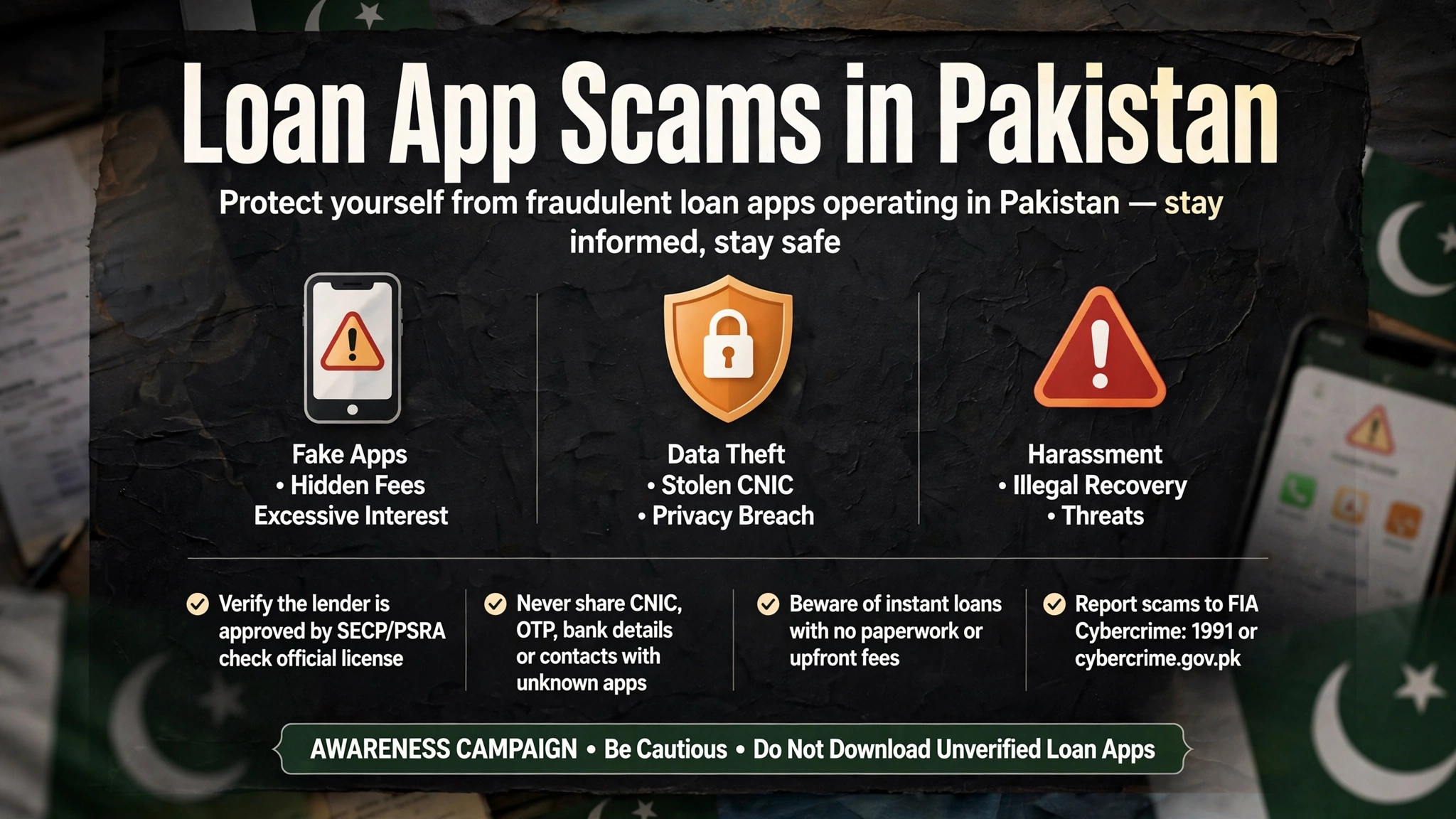
Before installing anything, search the company name on the SECP’s official website to confirm it holds a valid NBFC license for digital lending. If the app isn’t listed, don’t proceed, regardless of how professional its marketing looks.
Check What the App Asks For
A legitimate lender needs your CNIC, income details, and basic contact information. It does not need access to your photo gallery, your full contact list, or your call history. If the permissions screen feels excessive, that’s your answer.
Look for the Key Fact Statement
Licensed lenders are required to present a Key Fact Statement before you accept a loan, clearly listing the interest rate, processing fees, total repayment amount, and tenor. If this document is missing, vague, or buried behind confusing language, walk away.
Read Independent Reviews, Not Just In-App Ratings
Search the app’s name alongside words like “complaint” or “harassment” before installing it. Genuine borrower experiences on forums and social media often surface problems long before an app is formally blacklisted.
Practical Steps to Avoid Loan App Scams
- Stick to licensed banks, microfinance banks, or SECP-approved NBFCs for any borrowing, even if the process takes slightly longer.
- Never grant contact or gallery permissions to a lending app under any circumstance.
- Read the loan agreement fully before accepting, including fee structures and late payment penalties.
- Avoid apps shared through WhatsApp links or unofficial websites; stick to official app stores where possible.
- Borrow only what you can realistically repay on schedule, since late payments are exactly what predatory apps are designed to exploit.
- Cross-check the lender’s name against the SECP’s public list of registered and blacklisted apps before applying.
- Uninstall and revoke permissions immediately if an app behaves suspiciously after installation, even before taking a loan.
What to Do If You’ve Already Been Scammed
If you’ve already borrowed from a fraudulent app or are facing harassment, act quickly rather than staying silent out of embarrassment or fear:
- Stop communicating with the lender directly once threats or harassment begin; continued engagement rarely resolves anything and often escalates pressure tactics.
- Document everything. Save screenshots of messages, calls, and the loan terms shown in the app before you lose access to it.
- Report the app to the FIA Cybercrime Wing, either through their helpline or nearest Cybercrime Reporting Centre. This is the correct authority for harassment, blackmail, and unauthorized data access tied to loan apps.
- File a complaint with the SECP if the operator is falsely claiming NBFC registration or operating without one.
- Revoke app permissions and uninstall it from your device, then change passwords on accounts that may share login credentials.
- Warn your contacts that messages appearing to come from you regarding a loan may actually be sent by the scam operator, so they aren’t caught off guard.
- Talk to someone you trust. Blackmail campaigns are designed to isolate victims through shame; involving a family member or friend early often defuses the leverage the scammer is counting on.
Conclusion
Loan app scams in Pakistan thrive on urgency, low financial literacy, and a regulatory gap that operators are quick to exploit by rebranding and redistributing once one version gets shut down. The good news is that the warning signs are consistent and learnable: unlicensed operators, excessive permission requests, missing fee disclosures, and pressure tactics almost always show up before real harm begins. By verifying SECP registration, reading permissions and loan terms carefully, and knowing exactly where to report trouble through the FIA and SECP, borrowers can take advantage of legitimate digital lending without becoming the next case study in a crackdown announcement.