Iran vs Israel War: A Complete Technology Comparison in Modern Warfare
Iran vs Israel War: A complete technology comparison in modern warfare — AI, drones, missiles, cyber ops, and who holds the real military edge in 2026.
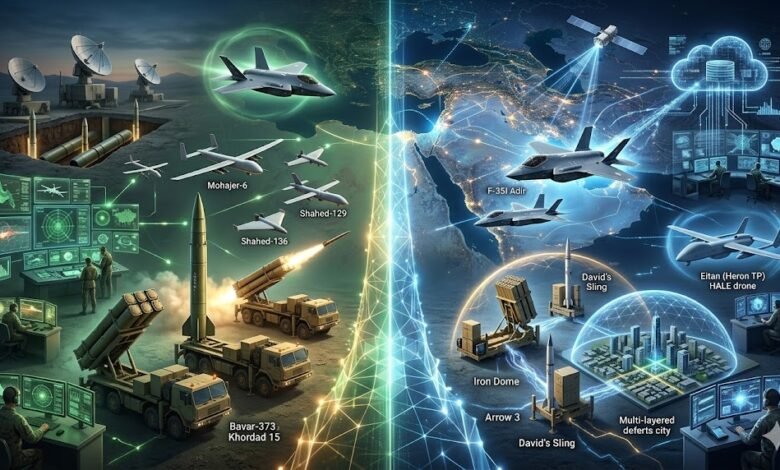
The Iran vs Israel War did not look like any conflict the world had seen before. No massive ground invasions. No trenches. No armies marching across open fields. What the world watched unfold — particularly during the 12-day conflict of June 2025, codenamed Operation Rising Lion — was a war fought almost entirely through machines, algorithms, precision munitions, and layers of defensive technology stacked so high they reached the edge of outer space.
This confrontation between two of the Middle East’s most capable military powers exposed just how completely modern warfare technology has replaced traditional combat. Israel brought to the fight a tightly integrated arsenal of AI-driven targeting systems, stealth aircraft, laser-based interception tools, and drone fleets operating with near-autonomous precision. Iran countered with a dense inventory of ballistic missiles, swarms of low-cost drones, and, in some cases, missiles with hypersonic capabilities that genuinely tested Israeli defenses.
What makes this conflict so important to study is not just who won or lost. It is what both sides revealed about where military technology is heading. The weapons deployed, the systems activated, and the doctrines applied in this war will almost certainly shape how every major military power thinks about defense and offense for the next two decades. This article breaks it all down — platform by platform, system by system — in a direct, honest comparison.
Iran vs Israel War: The Technology Gap at a Glance
Before getting into specifics, it helps to understand the overall picture. According to the 2026 Global Firepower Index, Israel is ranked 15th out of 145 countries while Iran sits at 16th — a narrow gap on paper, but the two militaries differ significantly across key areas such as manpower, technology, and strategic capabilities.
The critical detail here is what lies beneath those rankings. Iran holds a significant advantage in raw manpower. Iran outperforms Israel in terms of manpower, maintaining its 15th position globally in comparison to Israel’s 91st spot and holding the eighth place in terms of active personnel. But as analysts have pointed out repeatedly, troop numbers tell very little about the outcome of a technology-driven conflict.
Analysts caution that sheer numbers are unlikely to determine the balance of power, as modern warfare increasingly hinges on technology. That is exactly what the June 2025 war confirmed.
Air Power: Israel’s F-35 vs Iran’s Aging Fleet
Israel’s Air Force Capabilities
Israel’s air force is arguably its most powerful asset. With more than 600 aircraft, including advanced fighter jets, attack helicopters and intelligence platforms, Israel emphasises precision strikes, real-time intelligence, and electronic warfare.
The centerpiece of Israeli airpower is the F-35I Adir — Israel’s domestically customized version of the F-35A. The F-35I likely carries some sophisticated electronic warfare systems and can use its stealth to open holes in Iranian air defenses for non-stealthy F-15s and F-16s to use. Israel also fielded the F-15I Ra’am and F-16I Sufa, both heavily upgraded platforms that have been modernized with Israeli-developed avionics and electronic warfare suites.
Over 200 Israeli aircraft participated in Operation Rising Lion, dropping more than 330 munitions on approximately 100 targets across Iran. The strikes relied heavily on advanced Israeli-made munitions developed over the past two decades. These precision-guided weapons were crucial in achieving operational surprise and establishing air superiority over Iran.


The United States also played a supporting role. The US reportedly deployed stealth aircraft including the B-2 Spirit bomber, as well as F-22 and F-35 fighters, alongside electronic-warfare aircraft such as the EA-18G Growler. Naval forces launched Tomahawk cruise missiles from destroyers and submarines, targeting hardened sites and air-defense networks.
Iran’s Air Force and the Asymmetric Response
Iran’s conventional air fleet is considerably older. Iran’s fleet totals slightly fewer aircraft, with many older models. To balance this, Tehran has invested heavily in drones, cruise missiles, and layered air-defense systems that extend its ability to strike from a distance and defend key areas without relying solely on conventional aircraft.
This is not a sign of weakness so much as a deliberate strategic pivot. Iran recognized decades ago that trying to match Western-supplied Israeli airpower jet-for-jet was a losing proposition. Instead, it built an asymmetric offense: cheap, scalable, and saturating.
Drone Warfare: Who Owns the Sky?
Israel’s Drone Dominance
One of the most striking revelations from the June 2025 conflict was the sheer scale of Israeli drone operations. Israeli drones carried out thousands of flight hours, executing over 500 attacks and preemptive strikes against missile launchers and critical infrastructure. Combined with the ongoing campaign in Gaza, drones accounted for 60% of the Air Force’s flight hours and 50% of all IDF countermeasures during the war.
Israel used a mix of long-range surveillance drones, precision strike UAVs, and short-range swarming platforms. Israel’s mix of short-range drones and covert action with conventional tactical aircraft and flexible loadouts is proving to be a winning combination. For a force that prizes precision, flexibility, and payload, a mix of evolutionary platforms like the F-35I, F-15I, and F-16I with traditional long-range drones and short-range, inexpensive swarming drones appears to be getting the job done better than any one of those things alone.
Perhaps most importantly, Israel’s Mossad pre-positioned drone arsenals inside Iranian territory ahead of the main strikes. Mossad commandos established drone arsenals that were used against a series of air defenses located in Western Iran. This was covert drone warfare at a level most military planners had only theorized about.
Iran’s Drone Arsenal
Iran has invested enormously in drone technology as a core part of its offensive doctrine. Iran has spent years building an extensive drone arsenal, including the Shahed-131 and Shahed-136 families, as well as heavier platforms designed for longer-range strike missions and mass deployment. The widespread use of these platforms reflects a broader shift in warfare: the growing importance of scalable systems that can be produced and deployed in large quantities.
Iran’s drone strategy is essentially a saturation play. Launch enough of them and some will get through. Iranian doctrine increasingly emphasizes combined waves of drones and missiles designed to saturate defensive systems, launching multiple threat types simultaneously to overwhelm interception capacity, exploit gaps in layered defenses, and impose an unfavorable cost exchange on defenders.
The strategy has worked to a limited degree. It appears that Iranian strikes made it very difficult for the Israeli multi-layered air defense system to intercept all of them. But the overall interception rate still tilted heavily in Israel’s favor.
Missile Technology: Ballistic Power vs Layered Defense
Iran’s Missile Arsenal
Iran’s ballistic missile program is one of the most advanced in the region and represents its most credible strategic threat. Iran’s response has relied heavily on its missile arsenal, including ballistic and cruise missile families such as Shahab, Sejjil, and Khorramshahr.
What caught analysts’ attention during the conflict was Iran’s use of AI-enhanced guidance systems in some of its missiles. Those ballistic missiles integrate AI systems in order to be able to self-correct their trajectory at Mach 5. While there is a debate about it, it appears that some of these hypersonic missiles were launched against the multi-layered Israeli defenses.
The Iranian Fattah hypersonic missile became a particular talking point. Reports indicated that the interception of the Iranian and possibly hypersonic missiles took place at 300 to 400 km altitudes — well above the 100 km Kármán line that defines the limit between the atmosphere and outer space. This pushed Israeli and US defense systems to their absolute ceiling.
Israel’s Multi-Layered Defense Architecture
Israel’s missile defense network is the most sophisticated layered system outside of the United States. It consists of four primary tiers:
- Iron Dome — designed to intercept short-range rockets and mortar shells at low altitude
- David’s Sling — targets medium to long-range missiles
- Arrow 2 and Arrow 3 — designed for long-range ballistic missile interception at high altitudes
- Iron Beam — Israel’s new directed-energy laser system, operational for the first time at scale in this conflict
Operation Rising Lion was first and foremost a war of technology. Yuval Steinitz, chairman of the board of Rafael Advanced Defense Systems, described it as “a clear demonstration of advanced technology that gave Israel an edge — technology doesn’t only give an advantage, but the utmost supremacy over our enemies.”
The Iron Beam laser system deserves particular attention. “We’ve shown in tests that the Iron Beam laser system can intercept rockets, cruise missiles, UAVs, and 155mm artillery shells.” The modular version, known as Iron Beam M, which can be placed on jeeps or other mobile platforms, was proven during the war to be very effective at intercepting drones.
The cost efficiency argument for laser weapons is enormous. A laser intercept costs a fraction of a cent in electricity versus thousands of dollars per missile intercept. As Iran deploys more drone swarms, directed-energy weapons become proportionally more valuable.
Despite these strengths, the system was not impenetrable. Between 13 and 20 June, some Iranian ballistic missiles were able to penetrate Israeli air defenses, the result of both the relative efficiency of the Iranian missiles and the overuse of the Israeli defense system. Every layered defense has limits — and Iran clearly knew how to test them.
Artificial Intelligence in Combat Operations
This was the dimension of the war that historians will likely study the most carefully for years to come.
How Israel Used AI on the Battlefield
The 2025 Israel-Iran war marked a historic milestone in modern warfare — the first large-scale military conflict in which artificial intelligence was not only integrated, but indispensable to battlefield operations. The coordinated Israeli-American strikes on Iran’s nuclear infrastructure were not merely conventional air raids. They were the outcome of a meticulously orchestrated digital war plan that leveraged AI to enable unprecedented tempo, reach, and precision.
The role AI played was not about autonomous killing. It was about speed and coordination. AI served as a force multiplier — accelerating the tempo of decision-making, enhancing the quality of data fusion, and optimizing strike efficiency. But all final strike authorizations required human validation.
Without this AI infrastructure, Israel would have likely achieved no more than 5 to 10% of its target list, or would have been forced into a prolonged war of attrition. That is a staggering admission about how dependent modern precision warfare has become on machine intelligence.
Iran’s AI Capabilities — and Their Limits
Iran’s AI integration is more rudimentary but not entirely absent. In May 2025, Ukrainian officials revealed the downed remnants of a fully autonomous Iranian drone equipped with AI-based targeting algorithms that required no human input. This system was capable of selecting and engaging targets based solely on behavioral data and pre-programmed mission parameters.
This is a double-edged sword. Fully autonomous targeting raises serious ethical and legal questions. The use of fully autonomous lethal systems without human oversight violates widely accepted ethical frameworks, including NATO’s AI principles and the OECD’s AI guidelines. It also introduces risks of unintended escalation, targeting errors, and loss of control in conflict zones — particularly in urban or civilian-dense areas.
Cyber Warfare: The Invisible Front
Cyber operations were an important pre-conflict layer of the Iran vs Israel confrontation, even if they receded during the kinetic phase. Israel’s Unit 8200 — its signals intelligence and cyber warfare arm — is widely considered one of the top offensive cyber capabilities in the world.
Iran’s cyber forces, affiliated with the IRGC and other entities, have been linked to multiple infrastructure attacks globally over the past decade. However, Iran’s response to Israeli strikes notably did not include significant retaliatory cyberattacks, with experts noting that cyber operations often require long-term planning and have limited ability to affect real-time kinetic warfare.
This is an important nuance. Cyber weapons are tools of long-term disruption and intelligence gathering. They are not generally suited to real-time battlefield response. Both sides used electronic warfare more actively than cyberattacks during the shooting phase — jamming, spoofing, and suppressing the other’s radar and communications networks.
Space and Intelligence: Satellites, Surveillance, and the ISR Edge
Modern war depends on knowing where your enemy is at all times. ISR — Intelligence, Surveillance, and Reconnaissance — is the backbone of every precision strike.
Modern military campaigns increasingly rely on integrated intelligence, surveillance, and reconnaissance networks capable of processing large amounts of information quickly. AI-enabled tools are increasingly central to operational tempo — not as autonomous decision-makers, but as accelerators for analysis, planning, prioritization, and coordination. Such tools compress what military planners call the kill chain: detect, identify, decide, engage.
Israel operates its own reconnaissance satellite network, supplemented heavily by US intelligence assets. This gave Israeli planners a comprehensive real-time picture of Iranian military positions. Iran has its own satellite program but operates at a significant disadvantage in both resolution and timeliness of imagery.
The F-35I’s sensor fusion capabilities added another layer. The F-35 is also a capable sensor platform, and another concept of operations for the aircraft is to quarterback operations for other fighters — using its sophisticated sensors and network capabilities to direct efforts, provide jamming support, or pass targeting data to strikers.
Defense Spending and Military Budget Comparison
Money matters in modern warfare, perhaps more than any previous era. Advanced missiles, AI systems, stealth aircraft, and laser weapons all require sustained investment.
Israel’s annual defense budget, significantly larger than Iran’s, allows for extensive investment in cutting-edge technology, including missile defense systems such as Iron Dome and David’s Sling, cyber warfare capabilities, and intelligence systems. Iran’s smaller budget and economic pressures, including sanctions, have pushed it to develop indigenous weapons and focus on cost-effective systems like drones and missiles.
This funding gap has real consequences. Israel can afford to field the F-35, maintain multiple missile defense layers simultaneously, and fund continuous R&D cycles. Iran has to be clever — building large quantities of cheaper systems and hoping volume and ingenuity compensate for the quality deficit.
Interestingly, Iran’s approach is not without logic. A $20,000 Shahed drone that forces Israel to fire a $1 million interceptor missile represents a favorable cost exchange from Iran’s perspective — even in defeat.
Ground Forces and the War That Wasn’t Fought on Land
One of the most notable aspects of the June 2025 conflict is what didn’t happen. Neither Israel nor Iran deployed a significant number of ground troops, and there were no traditional battlefield engagements. Rather, the war was carried out with long-range ballistic missiles, precision air-to-ground munitions, cyberattacks, UAVs, and other autonomous systems.
Iran maintains a far larger ground force. Iran’s ground military operates with a substantial inventory — between 1,700 and 2,000 tanks, tens of thousands of armored vehicles, and a significant number of rocket launchers. These forces are structured for large-scale ground warfare and sustained operations.
But in a war fought primarily at range, that advantage was irrelevant. Israel’s ground forces feature fewer tanks and vehicles but rely on advanced targeting systems, mobility, and modernized artillery that support rapid maneuver and precision engagement on the battlefield. This difference reflects distinct defense doctrines: Iran emphasizes massed firepower and saturation, while Israel prioritizes technology and agility.
Naval Power and the Strait of Hormuz Factor
The naval dimension of this conflict centers on one geographic chokepoint: the Strait of Hormuz, through which roughly 20% of global oil passes daily.
Iran’s naval strategy focuses largely on control of nearby waters such as the Strait of Hormuz. It uses fast attack boats, missile-armed vessels, and coastal defense systems to challenge larger navies and protect strategic interests. Israel’s navy, though smaller, centres on submarines and missile-equipped vessels that protect its coastline and deter threats. Its submarine fleet plays a key role in strategic deterrence.
Israel’s submarine fleet is believed to be nuclear-capable — an unspoken but powerful deterrent in any escalation scenario.
Key Technology Comparison Summary
| Category | Israel | Iran |
|---|---|---|
| Air Power | F-35I, F-15I, F-16I — highly advanced | Older fleet, compensated by drones |
| Drone Warfare | Precision strike + swarm capability | Mass production, saturation doctrine |
| Missile Defense | Iron Dome, David’s Sling, Arrow 3, Iron Beam | Limited interception capability |
| Offensive Missiles | Precision air-to-ground munitions | Shahab, Sejjil, Khorramshahr, Fattah |
| AI Integration | Deep integration, human-on-the-loop | Emerging, some autonomous platforms |
| Cyber Warfare | Unit 8200, world-class capability | Active but less sophisticated |
| Defense Budget | Significantly larger | Constrained by sanctions |
| ISR / Satellites | Strong, US-supplemented | Limited, developing |
What the War Revealed About Future Conflicts
The most important lesson emerging from the battlefield is not about a single weapons system. It is about how very different technologies — expensive strategic platforms and scalable autonomous systems — now operate together as part of an integrated system of systems.
This war showed that the future of modern warfare technology belongs to nations that can:
- Integrate AI across every layer of the kill chain
- Field both high-cost precision systems and low-cost scalable ones simultaneously
- Maintain multilayered defense that cannot be economically depleted
- Operate in all domains — air, sea, cyber, space — at the same time
For further reading on AI’s role in contemporary military doctrine, the Council on Foreign Relations analysis on autonomous weapons systems offers excellent context. The US Naval Institute’s Proceedings journal has also published detailed operational breakdowns of Operation Rising Lion that are worth studying.
Conclusion
The Iran vs Israel War stands as the most technologically revealing conflict of the 21st century so far. Israel’s precision-guided munitions, AI-integrated targeting systems, multi-layered missile defense, and drone dominance gave it a clear operational edge over Iran’s saturation-based strategy of ballistic missiles and Shahed drone swarms. Iran is not without capability — its hypersonic missile program, mass drone production, and asymmetric doctrine genuinely stressed Israeli and American defense systems — but the gap in military technology, defense spending, AI integration, and real-time ISR proved decisive. The 12-day conflict confirmed that modern warfare is no longer about who has more soldiers; it is about who has smarter, faster, and more connected machines — and in June 2025, that answer was unambiguous.